
The Theory of Power Factor Testing — Part 2
By Rick Gaskey, AVO International
The first part discussed the basics of electrical power theory — real, reactive, and total power. This was shown by the use of the power triangle and right-angle theory. Within this discussion was the viewpoint of this theory from generation. Now, lets look at power factor from an electrical testing viewpoint.
Capacitance
As stated earlier, we want the power factor for this situation to generally be in the 0.0% to 2.0% range. Why? The answer is quite simple if one really stops to think about it. The first thing we must consider is the model of a capacitor. Capacitance is defined as two conductors separated by a dielectric. All insulating systems can and should be modeled as an ideal capacitor. However, one must remember nothing is ideal in the practical sense. We are merely talking about a model. One conductor of this modeled capacitor is the current carrying conductor. The other conductor is ground. This could come in the form of the metal frame of a circuit breaker or the tank of a transformer. The dielectric portion of the modeled capacitor is obviously the insulation.
We already discussed the properties of capacitance somewhat. Now let's expand a little more. The ideal capacitor is considered a totally reactive circuit. In other words, there is no resistive component associated with the capacitor. Remember, we are talking about an ideal capacitor and in the real world, there is nothing ideal. What this amounts to is some small amount of resistive current flow through all insulating systems. This resistive current is of the nano-amp to pico-amp range (for a good insulator), but nonetheless it is present. The resistive current flowing through the insulation is the current responsible for keeping us from achieving a 0.0% power factor. If there were no resistive current flow, we would have a totally reactive test specimen.
How can current flow through porcelain, oil, paper, or any other insulating material? The scientific explanation for this is quite simple. It comes in the form of valence electrons. Remembering basic electrical theory, valence electrons are the electrons on the outer shell of the atom and are responsible for current flow. All materials known to man have valence electrons associated with their molecular structure. Some materials such as copper and silver obviously have many more valence electrons than other materials since they are considered the best conductors available. Other materials, such as the insulators mentioned above, have very few valence electrons associated with their molecular structure; therefore, they are poor conductors of electricity. Regardless of how poor of a conductor they are, they still conduct electricity, just in very small quantities. Thus, current does and will flow through all insulators including those mentioned.
With a totally reactive test specimen, you would have a straight vertical line when referencing the power triangle as shown below. However, in reality the model would look more like the one shown next to the ideal model because nothing is ideal in the world of electricity.
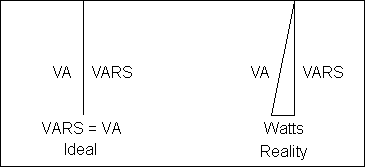
This only makes sense since the cosine of 90 degrees is equal to zero. We also know a couple of other characteristics about capacitors. For instance, we know an ideal capacitor is supposed to block DC current. Why? Just look at the equation below:
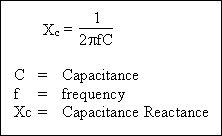
As the frequency approaches zero, the impedance approaches infinity. This should be obvious when one considers the application of Ohm's Law. The higher the impedance the smaller the current. What we are actually measuring is how un-ideal our capacitor or insulating system really is. In other words, how much of this resistive current is actually passing through the dielectric?
Test Set Operation
The power factor test set has a unique means of operating. While there are different manufacturers of power factor test equipment, all use the same principal of operation. The two most common power factor test sets in today's world are the AVO Delta 2000 and the Doble M4000. Both of these test sets use the principal of "zero reactance" to measure power factor. When we say zero reactance, we mean the reactive component (capacitance) is cancelled out by adding inductance into the test circuit. This is contrary to popular belief since many of the old null type test set models have dials labeled "Capacitance". In other words, there is a set of manual dials with numerals around their circumference. At the top of these dials, the word "Capacitance" is stenciled. These dials are rotated until a balance occurs on the null meter. What is actually happening? The test set is adding inductive reactance into the test circuit in order to cancel out the inherent capacitive reactance of the insulating system. Remember inductance and capacitance cancel each other out. There is a relatively large, tapped inductor (transformer) inside the test set that allows the addition of this inductive reactance. After all, what is an inductor? It is an insulated coil wrapped around a magnetic steel core. Sounds pretty much like a transformer to me. The test set uses this method of calculating the capacitance (how much inductance was added) of the test specimen. Once all the reactive power has been eliminated from the test circuit, the only portion left is resistive power (watts). This is a simple calculation; the test voltage (usually 10 kV) is multiplied by the remaining current, which is totally resistive, thus giving the watts loss value of the insulation. The test sets cannot distinguish between resistive and reactive current. The current initially seen by the test set is the total current or current found on the hypotenuse of the power triangle. The operation described above allows the test set to distinguish between the two different components of current.
Modes of Operation
The Power Factor Test Set comes with three basic modes of operation. These three modes of operation are referred to as the
GST stands for grounded specimen test while UST stands for ungrounded specimen test. While some of this may sound confusing, it should be understood that in application, it is actually a simple concept.
When considering these different modes of operation, we have to understand what conductors (test leads) are associated with each mode. There are four different leads that protrude from the test set and connect to the test specimen. Of these four leads, one is the high voltage output lead. The high voltage output lead actually has nothing to do with any specific mode of operation. Of the remaining three, one is the ground return lead (GST) and the other two are the red and blue UST leads. This is where the confusion can start. Of the two UST leads, only one is actually used in over 95% of the practical application. Therefore, in order to avoid confusion for the novice, we recommend that only one of these UST leads be connected to the test set.
What all this amounts to is quite simple. There are two paths of leakage current returning to the test set. One path is considered the ground path. Obviously, this would read the current returning on the ground lead (GST). In other words, the GST Guard tests read all the current leaking to ground only. The test set is guarding out the red or blue lead. Remember the UST lead (red or blue) still has current flowing on it, but is not being read by the test set in the GST Guard mode. The other path of leakage current returning to the test set is obviously the red or blue UST lead. The UST lead is returning leakage current to the test set that is not flowing to ground. Examples of this would be the leakage between the high side winding and low side winding of a transformer or the current leaking between the line side and the load side of an open circuit breaker. When the UST test is performed, the only current being measured by the test set is the current flowing on the red or blue lead. The ground leakage is present. It just isn't being measured by the test set.
The last mode of operation to discuss is the GST mode. Some like to refer to this as the GST no guard mode. When this mode of operation is selected, both leakage paths (ground lead and the red or blue lead) are being read by the test set. This gives the overall condition or power factor of the test specimen. When the GST test is performed, the current, watt loss, and capacitance parameters of the UST and GST Guard tests should algebraically sum to equal the same parameters in this GST test. This only makes sense, since we are still reading the same two leads. The difference is we are reading them together instead of reading them separately. This provides a good check of the test results. The sum of the UST and GST guarded parameters should equal the GST parameters. If this is not the case, either then the test set is malfunctioning or there is the age-old problem of operator error being introduced.
Conclusion
It should be easy to see from the previous discussion that understanding the modes of operation is not as hard as it first appears. We are simply reading leakage current back to the test set on each lead individually and then with the sum of the two together. Hence, there are actually only three modes of operation one should have to understand.
About the author
Rick Gaskey is an Applications Engineer for AVO International.